
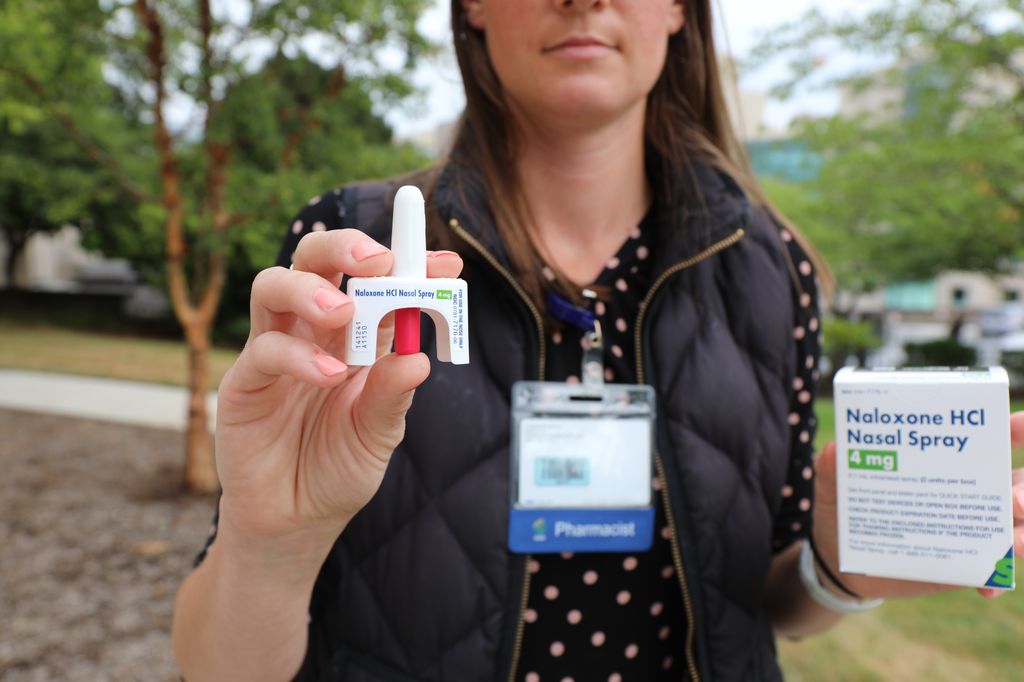
Three people die every day in Oregon from unintentional drug overdose, according to the Oregon Health Authority. In nearly half these cases, a bystander could have intervened if equipped with naloxone, or Narcan, which can reverse the effects of an overdose. Among youth overdoses, the ratio is even higher, with two out of three cases having a bystander present.
On Tuesday, Aug. 29, during the Farmers Market on Marquam Hill, Oregon Health & Science University experts will provide information and training on how to use naloxone. The event is part of International Overdose Awareness Day — which is officially Thursday, Aug. 31 — a global campaign to reduce stigma and raise awareness about overdoses and evidence-based overdose prevention methods.
A booth will be set up from 10 a.m. to 2 p.m. on Tuesday, Aug. 29, during the Farmers Market in the public grassy area in the center of OHSU’s Marquam Hill campus, near the fountain in front of Mackenzie Hall. Journalists are invited and should RSVP to news@ohsu.edu if they plan to attend.
The upward trend in overdose deaths across the country prompted the Food and Drug Administration to approve in March 2023 reclassifying naloxone nasal spray as an over-the-counter, nonprescription medication. The public can purchase naloxone from store shelves later this year.
This month, Oregon approved expanding access to overdose reversal medications by making them more readily available in public buildings, stores, police departments and schools.
“These changes are a huge victory toward empowering bystanders, especially with the alarming rise in adolescent overdose rates,” said OHSU clinical pharmacist Emily Skogrand, Pharm.D. “Education is part of preventing overdose deaths, but having naloxone readily available in more public places is vital.”
International Overdose Awareness Day efforts at OHSU are a collaboration among OHSU’s IMPACT program, Office of Population Health, OHSU Health Integrated Delivery System (IDS) and CareOregon.
At event booths, volunteers will also have information on advancing a harm reduction culture at OHSU, and OHSU programs aimed at supporting individuals with substance use disorders, such as IMPACT and the Harm Reduction and Bridges to Care (HRBR) Clinic, a collaboration between OHSU and the Oregon Health Authority for people interested in taking medications to stop or reduce their use of drugs or alcohol.
OHSU’s IMPACT is expanding to Adventist Health Portland in October. The team will include physicians, a social worker, harm reduction nurse, pharmacist and peer support specialists.