
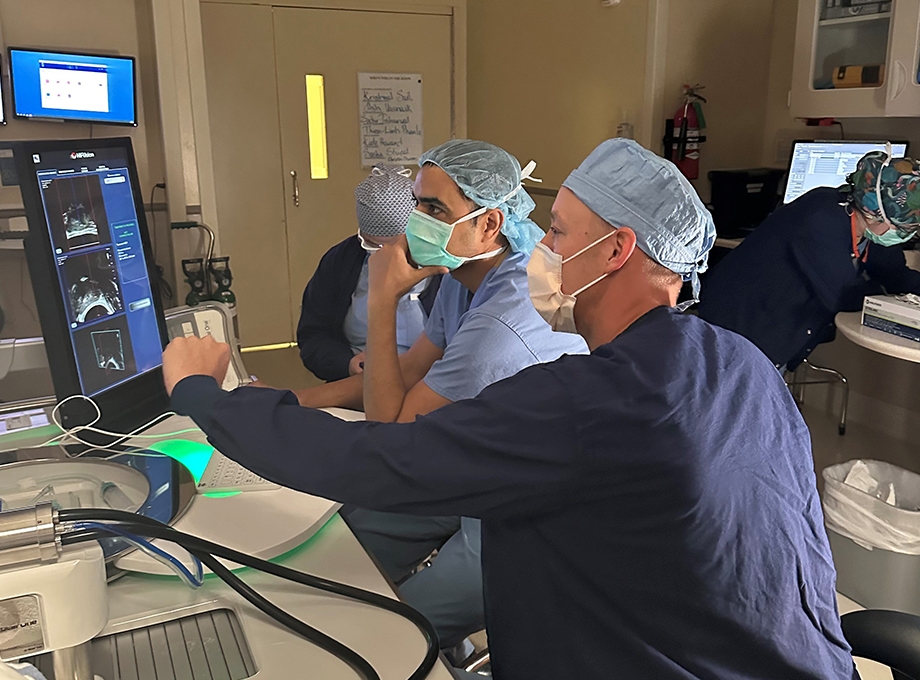
Men with prostate cancer in Oregon have a new option for treatment that destroys the cancerous tissue while minimizing side effects.
On March 27, Oregon Health & Science University was the first hospital in Oregon to offer the treatment using a robotic-assisted high-intensity focused ultrasound device at the hands of surgeon Sudhir Isharwal, M.D., associate professor of urology in the OHSU School of Medicine. It’s the only site between Seattle and Northern California where the treatment is available.

Isharwal said the therapy is useful for patients who have a single focal point of cancerous tissue, which accounts for roughly a third of all prostate cancer patients.
“Almost all of them sign up because it’s a noninvasive way to treat prostate cancer,” Isharwal said. “Patients don’t want the side effects, and they want to have cancer control.”
Side effects of radiation and surgery can include urinary incontinence and erectile dysfunction, which make a minimally invasive alternative appealing for patients who receive a referral to OHSU through their oncologist or primary care physician.
OHSU initially is providing it monthly through a lease arrangement with manufacturer Focal One, and Isharwal expects high demand. About one in eight men will be diagnosed with prostate cancer during their lifetime, according to the American Cancer Society.
The first patient to undergo the procedure at OHSU says he’s a believer.
“I could bet on comfortably 15 to 20 years tacked onto my life because I went through this,” said Kristofer Parks, 74, of Washougal, Washington. “If we can catch the cancer and preserve everything else, that’s a freebie.”
Parks, an Army veteran who served in the Vietnam War, said he was referred to Isharwal by his oncologist through the VA Portland Health Care System, following a series of screenings and imaging scans.
“I have nothing but great things to say about them and what they’ve done for me,” Parks said.
The technique relies on high-frequency focused ultrasound to ablate, or burn, cancerous tissue as long as it’s within the first 4 centimeters of the prostate. OHSU began using a similar technology three years ago in neurosurgery patients, targeting a focal point of the brain causing a condition known as essential tremor.
Comprehensive options for minimally invasive treatment
OHSU has a comprehensive suite of options available for patients with prostate cancer, including a minimally invasive procedure that OHSU began offering in 2022, known as NanoKnife. In that technique, a targeted electrical current is used to target cancerous tissue, thereby eradicating the cancer while minimizing side effects.
Harvey “Rick” Holland, 58, of Grants Pass, was the first patient in April 2022 to undergo the NanoKnife procedure at OHSU. Holland, a retired mechanic with a family history of prostate cancer, said he has had no lingering effects and recommends the procedure to others.
“It was just in and out,” he said. “It worked perfectly for me.”
Isharwal said the specific intervention depends on various factors for each patient, including the location of the cancerous tissue.
“We’ll be able to take care of anybody who’s a candidate for surgery,” Isharwal said.