OHSU patient battles colorectal cancer on journey to Boston Marathon


Humans are faced with hundreds, if not thousands, of decisions daily. For Matt Hazard, there may not have been a better decision than to listen to his cousin and lifelong friend, Koree Anderson, on June 19, 2024.
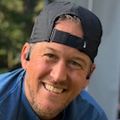
Hazard, who was training for the Eugene Marathon, noticed an abnormal amount of blood in his stool just two days before the race. Initially, he chalked it up to the red electrolytes he was drinking during training and shrugged off the symptoms. He ran the marathon, qualifying for the 2025 Boston Marathon in the process.
Fast forward a month, and the symptoms returned. Hazard scheduled a colonoscopy — and then canceled it a week before the procedure, after realizing what the out-of-pocket cost would be.
But his cousin, who had been diagnosed with stage four colon cancer just months before, nudged Hazard to reconsider. Hazard decided to listen.
“I caught word that Koree was mad at me about it, so I rescheduled it,” Hazard said. “Then one day I woke up and was told I had colon cancer.”
He was 40 years old.
Decision point: Get screened
Hazard was diagnosed with stage-four rectal cancer with synchronous metastatic disease to his liver, meaning both were found at the same time.
“The cancer in his liver is a spread of his rectal cancer, which goes in the veins that drain the rectum and get circulated through your system and are filtered in your liver,” said Skye Mayo, M.D., M.P.H., FACS, a surgical oncologist in the OHSU School of Medicine and Knight Cancer Institute who specializes in liver and pancreatic cancer and was part of Hazard’s care team at OHSU from the start.
“That’s why all gastrointestinal cancers end up with liver metastasis,” he said. “The disease spreading to the liver is what makes it a stage-four diagnosis.”
For Hazard, it was a shocking diagnosis, but it is one that follows a trend of colon or rectal cancers rising in adults younger than 50. Between 2012 and 2021, that rate increased by 2.4% per year, according to a study by the American Cancer Society.
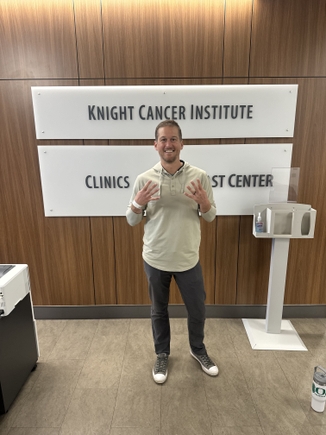
According to the American Cancer Society, in 2018, the recommended age for an individual with an average risk of colon cancer to start regular screening was 50. Seven years later, the age has been lowered to 45.
To this day, the weight of that singular decision — to get screened or not to get screened — still weighs heavily on Hazard.
“I might not be here right now to be honest, because if we hadn’t caught it, if we hadn’t started chemo when we did, who knows, it could have spread so much more,” he said. “I always say Koree saved my life. I hate saying that because he’s not with us anymore and passed in November 2024, but he really did.”
Multimodal, multidisciplinary care
To identify the best treatment plan for Hazard, OHSU’s gastrointestinal oncology specialists laid out all the evidence and guidelines. It would require a multidisciplinary approach to provide Matt with the individualized care he needs. His OHSU School of Medicine care team consisted of Mayo; Hagen Kennecke, M.D., M.H.A., FRCPC, an oncologist specializing in early detection, preventive therapy and treatments for gastrointestinal cancers; Daniel Herzig, M.D., M.B.A., FACS, FASCRS, a surgical oncologist; and Nima Nabavizadeh, M.D., a radiation oncologist, all in the OHSU School of Medicine and Knight Cancer Institute.
“It was all of us working together,” Mayo said. “For Matt, we felt that he should have treatment with chemotherapy first, then the operation on his liver, then radiation, then remove his primary cancer to give him the best chance.”
Hazard began treatment at OHSU in August 2024. He ultimately completed eight rounds of aggressive chemotherapy, followed by an operation on his liver.
“The only way for a cure is to have a resection or a local treatment of the liver tumor,” Mayo said.
The resection, or partial removal of the liver, would be done robotically with Mayo at the controls. OHSU has one of the largest robotic surgery departments on the West Coast, and for Hazard, it was the right tool for the job. By using robotics, Mayo was able to approach the liver in a targeted way through several small incisions, allowing Hazard to train for his marathon much sooner.
“It’s a testament to the team approach that we have and how we manage patients,” Mayo says. “Matt’s outcome and his ability to do what he did were the result of all of us working together to take care of him.”
Once the resection of the liver was complete, the team turned its focus on the rectal cancer. With Hazard’s input, they prepared a treatment plan that would allow him to maintain his athletic lifestyle.
“I met with him and his wonderful family on multiple instances at the beginning of this therapy as we weighed the different curative options available for his stage-four cancer,” Nabavizadeh said. “The balance of maximal therapy versus his quality of life and ability to do the things Matt wanted to do was a challenging one. OHSU has been a national thought-leader on non-operative therapies for rectal cancer, and Matt has so far been a beneficiary of this approach, allowing him to run the marathon without a delay.”
The specialized, tailored care plan worked. All of Hazard’s tests show he is now cancer-free.
Now, he heads to OHSU only for intermittent monitoring and checkups.

“Matt’s journey is inspirational to all patients with rectal cancer,” Kennecke said. “He underwent multimodality therapy and surgery, and at this time, there is no evidence of any residual cancer. The rectal cancer therapy allowed him to avoid surgery and minimize treatment toxicity.”
‘I never stopped’
Despite the emotional and unexpected news of a cancer diagnosis, Hazard made a point to be mentally locked in: There would be no waiting. There would be no hesitancy. He would attack the cancer from day one and not let up.
“I never really thought about dying,” he said. “I thought, ‘What's next? What do I need to do to get rid of this?’”
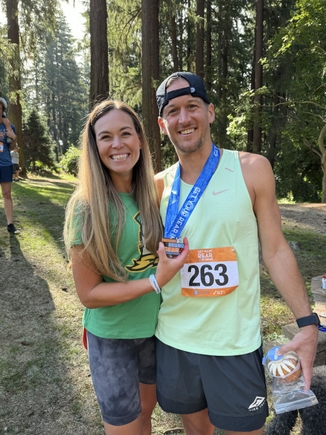
Hazard recalls turning to his wife, Amanda, in that moment after learning his diagnosis and telling her, “I’m going to fight.” And that’s what they have been doing ever since.
“She has been my biggest supporter and advocate through this journey, and her relentless efforts kept me fighting even when I didn’t want to — all while being an amazing mother to our two children,” he said.
Running has always been a passion for Hazard. Growing up, he ran in the state championship during high school and for a year at Southern Oregon University. Eventually other priorities, such as getting married and becoming a father to two sons — Colton, 6, and Easton, 4 — took over.
However, once he turned 40, running became not just a passion, but a necessity, igniting the flame to train for marathons and providing additional motivation to fight his cancer diagnosis.
“I’m not going to stop running. I’m going to trust my body and try to put myself in the best position to fight this,” he said. “Every time I would finish a run, I would point to my abdomen and say, ‘F-you!’”
Boston Marathon
With the Boston Marathon slated for April 21, 2025, Hazard’s training did not take a backseat. He ran 10 out of every 14 days, in between chemo treatments, only taking six weeks off for liver surgery.
Kennecke saw the positive impact exercise had on his recovery firsthand.
“Matt used exercise to combat cancer symptoms, and it may even have helped him beat this cancer,” he said. “And Matt is living proof that physical activity is key to cancer care.”
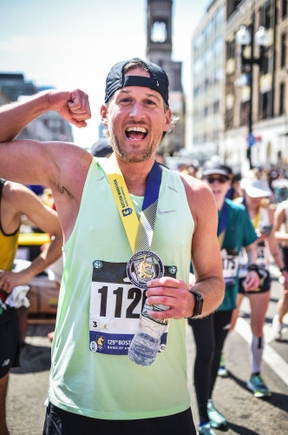
The journey to the Boston Marathon was emotional, exhausting and exhilarating. So, when Hazard and his family finally reached their destination, they made sure to arrive nearly a week early and soak up the entire experience.
Then race day arrived — the moment he had been fighting for.
“Running the race was so surreal,” he said. “I went out way too fast, but I was doing well until about 17, 18 miles in, and then I hit a wall going up the hills. But my mom was battling breast cancer at the time, and I channeled her battle along with my cousin’s.
“I didn’t give up, because I wanted to do it for them.”
After the race was completed, Hazard said he looked around, took in the sights and sounds, put his hands on his knees and said, “I’m done. I did it.”
Since the Boston Marathon, he has gone on to run in the annual Hood to Coast Relay and is looking to participate in the Eugene Marathon in spring 2026. And he has his sights on a big goal: to run all seven world marathon majors.
Decision point: Becoming an advocate
From the start, Hazard said he and his family felt the need to share their story on social media. They wanted that support, that encouragement, to know they had people in their corner cheering them on. But there was another reason for the transparency: Hazard wanted to become an inspiration to others and advocate for colorectal cancer awareness.
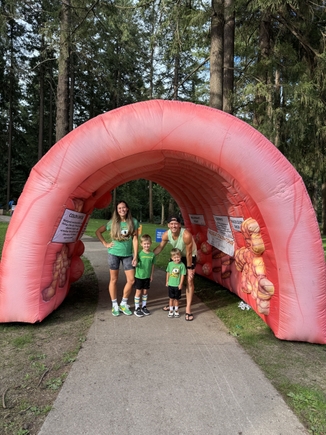
“We kept posting about my running, and I’d be going on long walks with my chemo bag on, and we started seeing that it was inspiring other people, and that really helped us and them,” he said. “It just became contagious.”
As they learned Hazard’s story, friends, family and neighbors began making the same decision that saved Hazard’s life: getting colonoscopies.
In March, Hazard was invited by the Colon Cancer Coalition to attend the PGA Tour’s Cologuard Classic in Tucson, Arizona, where he was inspired by the numerous advocacy groups and individuals who have been promoting colon cancer awareness for decades.
“Now that the dust has settled, I want to focus my attention on awareness so we can make sure people take care of themselves and advocate for themselves,” he said. “I don’t want this to happen to anybody else.”
There is no “off” switch when it comes to Matt Hazard, as his care team attests. He keeps going, keeps pushing. When he puts a goal in his sights, they say it’s easy to envision him succeeding.
“Matt’s story is one of perseverance,” Nabavizadeh said. “He has a fantastic attitude, and we are so proud of him.”