
Ariel Shaak noticed a lump in her right breast. She shared her concerns with her primary care clinician during an annual check-up. Because she was only 30 at the time, her clinician said the lump was likely nothing of concern.
But Shaak’s mother urged her to get a second opinion. A second clinician recommended breast imaging that same day, and a biopsy was performed that afternoon. The biopsy revealed she had Stage 1 triple-negative breast cancer, an aggressive form of the disease that can be difficult to treat.
“I think a lot of young women get passed over,” Shaak said. “People think they’re too young to get breast cancer. Obviously, that wasn’t the case for me.”
Treatment and family planning
Shaak had turned 30 in January 2016 and was diagnosed in October that year. She wasn’t married, didn’t have children and hadn’t begun any future family planning.

“I felt like I was still young enough to wait a little bit before making those big decisions,” she said. “But that option was taken away from me.”
Before starting chemotherapy to treat her cancer, Shaak had an egg retrieval with the goal of preserving her fertility options.
“You’re 30 years old and you don’t think you’re going to get cancer,” she said. “It took over my life immediately: first the egg retrieval, then chemo. It was a strange new world to suddenly adapt to.”
After eight rounds of chemotherapy to reduce her tumor, Shaak underwent a full mastectomy to remove both breasts.
Remaining hopeful despite cancer recurrence
A year later, Shaak received the heartbreaking news that her cancer had returned, metastasizing to her lung. She underwent a lobectomy, or surgery to remove a lobe of her lung, to get rid of the cancerous tissue.
After recovering from lung surgery, there were unfortunately more setbacks to come. Her mother took her to the emergency room one day because she was acting very strangely. Following a host of tests, Shaak learned her cancer had spread to her brain. And it wasn’t just one tumor that had spread – there were 11.
While her first brain surgery was successful, Shaak experienced several other cancer recurrences in her brain, followed by several more surgeries to remove the tumors.
“I never lost hope,” she said. “I took it one step at a time. It was just another hurdle to get over.”
A tailored OHSU clinical trial
In between surgeries, Shaak began seeing Zahi Mitri, M.D., Ph.D. Mitri is no longer at OHSU, but at the time, he led the breast cancer program for a new, first-of-its-kind clinical trial program designed to identify novel combinations of drugs that could stop tumors before they adapt and become drug-resistant.
The clinical trial program he recommended is called SMMART, or Serial Measurements of Molecular and Architectural Responses to Therapy. SMMART performs many leading-edge analyses of each individual’s tumor. The patient’s data is then reviewed by a SMMART Tumor Board comprising many different experts who then recommend the best treatment options for that specific patient. The goal is to identify new combinations of drugs to use, like a one-two punch, to stop tumors before they can adapt and become drug-resistant. Another goal is to better understand why standard therapies often stop working over time, to help design more effective treatment approaches.
As a result of the data collected in SMMART – including the knowledge acquired from two SMMART clinical trials with other triple-negative breast cancer patients with promising outcomes – Mitri and the SMMART team were able to acquire off-label drugs for Shaak, meaning a therapy not yet prescribed for her specific type of cancer.
“Dr. Mitri was really encouraging, and I had a great connection with him,” she said. “He’s the one who suggested I consider immunotherapy and Lynparza treatment, which would spare me from having to go through chemo again. I trusted Dr. Mitri and took a chance on that. It ended up being a really good thing for me.”
After starting treatment recommended in collaboration with the SMMART program in 2018, she had her last gamma knife surgery in 2020 and hasn’t had a cancer recurrence since.

“Ms. Shaak’s story is the outcome we hoped for when we created the SMMART program,” said Gordon Mills, M.D., Ph.D., Wayne and Julie Drinkward Endowed Chair in Precision Oncology, director of precision oncology at the OHSU Knight Cancer Institute and leader of the SMMART program. “Triple-negative breast cancer – particularly when metastatic and with brain metastases – has a poor prognosis with limited response to current treatment protocols.
“This outcome is a testament to what SMMART is trying to do for each of our patients. The treatment she received was in lockstep with the AMTEC [Adaptive Multitherapy Trial of Evolving Cancers] trial which was the only clinical trial worldwide that acts on how the tumor changes in response to treatment. Our hypothesis is that you must assess how the tumor changes in response to therapy and then act on the change in the tumor and whole tumor ecosystem.
“That nimble approach certainly benefited Ms. Shaak.”
Becoming a mother
In August 2021, Shaak married her “wonderful and supportive husband,” Dan. As a result of her positive response to treatment, the couple was able to make a big decision, in consultation with Ariel’s care team: Due to her positive response to therapy, she was able to take a break from treatment to try for a child.
She stopped immunotherapy and other treatment in 2023 and was pregnant later that year.
“A couple of days went by after taking a test and I was like ‘no way!’ Then I took another test and still couldn’t believe it! After being diagnosed with cancer at 30, I wasn’t sure I would ever be a mother. It’s an amazing gift.”
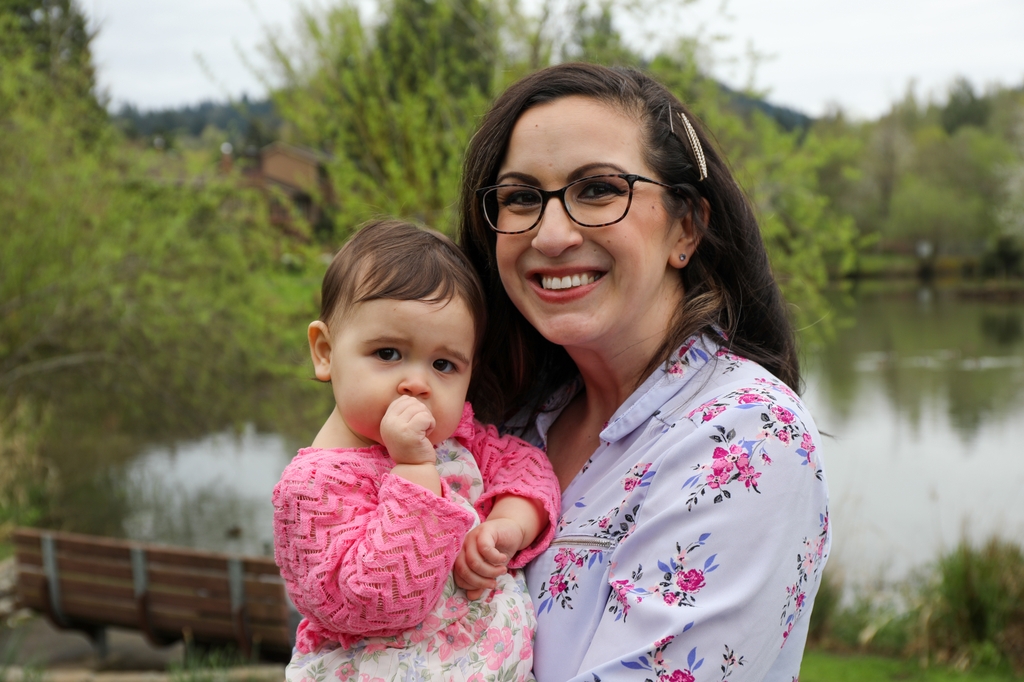
Her baby girl, Makenna, was born in March 2024.
Shaak says she sees her journey with cancer as something that has helped her grow and become a more caring person.
“I think I’m more of a patient person now. I’m more loving, more caring.”
Shaak says she is grateful to her entire family, including her husband, daughter, stepson, Hunter, parents, sister, grandparents, and aunts and uncles for how much support they gave her.
“They were so supportive toward me during my treatment, and I’m going to be sure they all know I will always be by their side, too.”
Maintaining a positive outlook
Since stopping treatment, Shaak is monitored closely, generally receiving new scans every two to four months to get ahead of potential recurrences. After the five-year mark, which is coming up soon, that monitoring timeframe will be reduced to every six months. Given the length of time off therapy, her care team is hopeful her tumor will not recur.
When asked how she kept her positive attitude through years of difficult treatment, she doesn’t hesitate.
“You could feel sorry for yourself, but it’s happened to you already. I try to look at the bright side of things and just keep going. My number one piece of advice is to take one thing at a time; don’t worry about what may be coming.”
Would she recommend someone with cancer considering a clinical trial?
“I’d say you should look at all the options you have to treat your cancer. Medicine’s changing every day. It’s amazing that we are able to have these clinical trial options available to us. I’m just so grateful.”